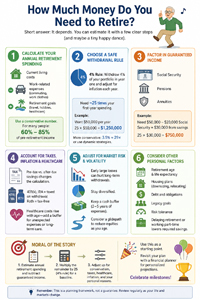
 How much money do you realistically need to retire? Short answer, it depends. But you can estimate it with a few clear steps (and maybe a tiny happy dance).
First, calculate your annual retirement spending. Start with current living costs. Then subtract work-related expenses (commuting, work clothes) and add retirement goals (travel, hobbies, healthcare). Use a conservative number. For many people this is 60–85% of pre-retirement income.
Next, choose a safe withdrawal rule. A common rule is the 4% rule. Withdraw 4% of your portfolio in year one and adjust for inflation each year. That implies you need 25 times your first-year retirement spending. For example: if you want $50,000 a year, 25 × $50,000 = $1.25 million. More conservative rules use 3.5% (≈29×) or dynamic strategies that respond to market returns.
Factor in guaranteed income. Social Security, pensions, or annuities reduce how much you must save. If Social Security will pay $20,000/year and you need $50,000, you only need to cover $30,000 through savings (25× = $750,000 using 4%).
Account for taxes, inflation, and healthcare. Pre-tax vs. after-tax savings change the calculation. Retirement accounts (401(k), IRA) are often taxed on withdrawal. Roth accounts are tax-free. Healthcare costs typically rise with age so add a buffer for unexpected expenses or long-term care.
Adjust for sequence-of-returns risk and market volatility. Early large losses can severely impact long-term withdrawals. Consider a diversified portfolio, a cash buffer (2–5 years of expenses), or a glidepath reducing equities as you age.
Other personal factors: desired retirement age, life expectancy, housing plans (downsizing, relocating), debt, legacy goals, and risk tolerance. Delaying retirement or working part-time lowers required savings.
Moral of the story:
A practical framework includes estimating your annual retirement spending and subtracting guaranteed income. Then multiply the remainder by 25 (4% rule) for a baseline. Finally, adjust up for conservatism, taxes, healthcare, and personal reasons. Use this as a starting point and revisit with a financial planner for personalized projections. Be sure to celebrate your milestones.