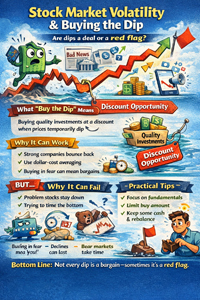
 Stock market volatility and the “buy the dip” debate go hand in hand. If the market had a personality, it would be that dramatic friend who’s thriving one minute and spiraling the next. Prices swing based on earnings, economic data, global events, central bank moves, and even whatever is trending online. For investors, it’s equal parts opportunity, risk, and emotional cardio.
“Buy the dip” means treating short-term price drops as a chance to grab quality investments at a discount. The idea is that markets tend to recover, so temporary declines are often just noise. For long-term investors, buying pullbacks can lower the average cost, like finally catching a sale instead of paying full price.
This strategy can work when strong companies rebound after panic-driven selloffs. It also pairs well with dollar-cost averaging and offers a behavioral edge: buying when others panic can mean snagging deals while everyone else is busy doom-scrolling.
But not every dip is a deal. Some stocks fall for real reasons, like weak fundamentals or industry disruption. Timing the exact bottom is…optimistic (and often followed by another dip). Repeatedly buying a struggling stock can turn a “bargain” into a long-term regret. In broader downturns, declines can last longer than expected, testing your patience, and your willpower not to check your portfolio every five minutes.
A practical approach starts with separating short-term dips from long-term problems. Focus on fundamentals like revenue, margins, cash flow, and competitive strength. Set clear rules for buying dips and limit how much you invest each time. Use dollar-cost averaging, keep some cash on hand, and rebalance to manage risk.
Investor psychology matters. Fear and greed amplify volatility, and headlines can drive decisions that ignore reality. Having a plan, and sticking to it, is key.
Moral of the story:
Buying the dip can improve long-term returns if done wisely. Just remember, not every drop is a bargain, sometimes it’s the market waving a red flag and you’re out here thinking it’s a clearance sign.