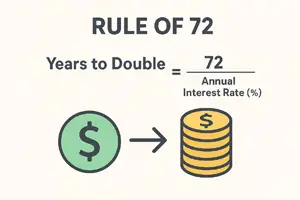
 This post is mostly for those of you who invest. Have you ever heard of the Rule of 72? Do you understand how it works? If not, this posting is for you.
The Rule of 72 is a quick formula that allows you to estimate the time it will take for your investments to double at any particular rate of return. To calculate your investment growth, use the following formula: Years to double = 72/annual interest rate (%) or the rate of return on your investment(s). For example, you have an investment that is earning 8%/year. Divide 72 by 8 which equals 9 years that it will take to double in value. Please note this is an approximation and is not exact. But it does give you an idea of how long it will take. It also assumes a constant rate of return which doesn’t normally happen. Neither of these occur in the real world which is why this formula only gives you an idea of how long it will take to double in value.
It’s also used to determine the effect of inflation on your purchasing power. It can predict how long it will take before your current purchasing power is cut in half. As in the previous explanation, it also assumes a constant rate of inflation which never happens either. The formula is as follows: Purchasing power = 72/inflation rate. Let’s say the inflation rate is 4%. Divide 72 by 4. The result is that it will take 18 years before your purchasing power is cut in half. Again, this is not an exact formula but can give you an approximation.
Moral of the story:
Remember, the Rule of 72 is not an exact mathematical formula. The Rule of 72 was created to give people an approximate timeframe to compare investment rates. Additionally, the Rule of 72 can be used the same way to project your purchasing power and inflation. Both formulas give you an estimated window for either doubling your money or halving your purchasing power. Use the Rule of 72 for planning. However, if you need more specific help, seek out a professional financial planner.