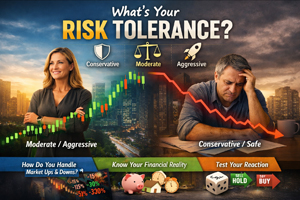
 Risk tolerance is the key to investing without panic. At its core, it’s how comfortable you are with uncertainty when it comes to your money—specifically, how much market ups and downs you can emotionally and financially handle while pursuing long-term growth. It’s not about how bold you think you are; it’s about how you actually react when markets drop, income changes, or unexpected expenses show up.
I see this difference clearly in my own household. I have a higher risk tolerance than my husband. Market swings don’t unsettle me the same way, while volatility makes him uneasy. As a result, he prefers safer, more stable investments, even if that means lower returns. Neither approach is wrong—they simply reflect different comfort levels with risk.
Most people fall into one of three risk tolerance categories: conservative, moderate, or aggressive. Conservative investors prioritize protecting their money and avoiding losses, even if growth is slower. Moderate investors aim for balance, accepting some volatility for steady long-term gains. Aggressive investors are willing to endure bigger swings in pursuit of higher returns. I fall between moderate and aggressive, while my husband is firmly conservative.
To find your own risk tolerance, start by reflecting on past experiences. How did you feel during market downturns or financial stress? Did you panic, stay calm, or see opportunity? Emotional reactions matter just as much as spreadsheets.
Next, consider your financial reality. Age, income stability, debt, emergency savings, and time horizon all influence how much risk you can reasonably take. Finally, imagine a real scenario: if your investments dropped 15% in a year, would you sell, hold, or buy more?
Moral of the story:
Understanding your risk tolerance helps you build a financial strategy you can stick with—one that supports growth without costing you sleep.