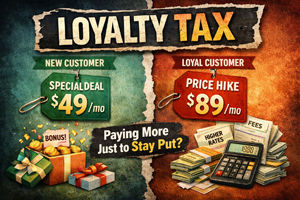
 The loyalty tax is the extra money you pay for doing business with the same company over time instead of switching. It quietly penalizes reliability, turning habit and trust into higher costs rather than rewards. Companies don’t thank you for staying, they charge you!
Years ago, I paid for television programming like many households did and do. Then, about ten years ago, I walked away. Every year the price increased, yet brand-new customers were offered deeply discounted rates I couldn’t access. The message was clear: loyalty wasn’t valued. I’ve since seen the same pattern across insurance policies, internet providers, and cell phone plans.
We’re conditioned to believe that loyalty pays off. In practice, it often doesn’t. Companies rely on the assumption that long-term customers are less likely to shop around. Autopay only strengthens that assumption. When payments happen automatically, small increases and quiet changes are easier to overlook. Over time, those incremental hikes can add up to hundreds—or even thousands—of dollars each year.
What makes the loyalty tax especially frustrating is that it punishes dependable behavior. If you pay on time, avoid lapses, and stay committed, you’d expect some benefit. Instead, companies often see loyal customers as the easiest group to raise prices on or reduce benefits for. I recently shared an experience with my medical insurance provider: while rates barely changed, coverage did. We explored other options but didn’t feel we had enough time or clarity to make a confident switch, so we stayed—for now—with a plan to research alternatives well ahead of the next renewal.
Correcting the loyalty tax requires intention. I review my homeowner’s and auto insurance annually and compare pricing on services like internet—even if I don’t plan to change immediately. Loyalty should be reciprocal. If a company doesn’t value my business, I won’t continue paying a premium just for familiarity.
Moral of the story:
Being a loyal customer shouldn’t cost more. And if it does, do what I do. I vote with your dollars and if a company won’t work with me, I no longer vote for them. I take my business elsewhere.