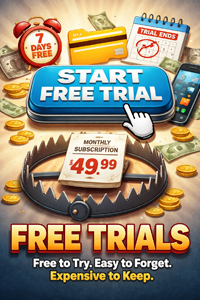
 Free to try. Easy to forget. Expensive to keep. Free trials are sold as risk-free. Try before you buy. Cancel anytime. No commitment. But in today’s subscription economy, free trials aren’t a courtesy—they’re a business model built on human behavior.
The trap isn’t the product. It’s the friction. Signing up takes seconds. Canceling takes effort, memory, and emotional energy. Companies rely on the fact that life gets busy. You forget the trial end date. The charge hits your account. By the time you notice, you’ve already paid once—so keeping it feels easier than undoing it.
Free trials also exploit a psychological bias called loss aversion. Once you’ve used a service for two weeks, canceling feels like giving something up, even if you didn’t need it in the first place. Add in saved preferences, playlists, progress bars, or stored files, and the product becomes “yours” before you ever consciously chose it.
Individually, these subscriptions seem small. $7 here. $12 there. But stacked together, they quietly drain your cash flow. Because the charges are predictable and recurring, they often fade into the background—until money feels tight and you can’t figure out why.
Moral of the story:
The free trial economy thrives on autopilot spending. It turns inaction into consent and forgetfulness into profit. Escaping the trap doesn’t require cutting everything. It requires intention. If you wouldn’t pay for it today, cancel it today. Free trials only stay free if you stay alert.