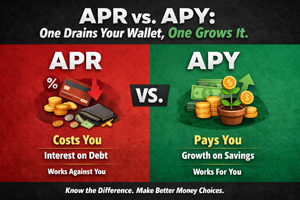
 Do you know the difference between APR and APY? Same letters, very different money outcomes. APR and APY are often used interchangeably, but they measure two very different things—and misunderstanding the difference can quietly cost you money.
APR (Annual Percentage Rate) represents the cost of borrowing money. It tells you how much interest you’re charged over a year on loans or credit cards, without fully reflecting the impact of compounding. APR is commonly used for mortgages, auto loans, personal loans, and credit cards. Because it focuses on the base interest rate, it can make borrowing appear cheaper than it actually is once interest begins compounding over time.
APY (Annual Percentage Yield), on the other hand, shows how much your money earns when you save or invest. APY includes compounding, meaning it reflects the true annual return on savings accounts, money market accounts, and certificates of deposit. The more frequently interest compounds, the higher the APY—even if the stated interest rate looks the same.
This distinction matters because APR works against you while APY works in your favor. A credit card with a 20% APR may feel manageable at first, but compounding interest can cause balances to grow quickly. Meanwhile, a savings account with a competitive APY allows your money to earn interest on top of interest, accelerating growth over time.
Moral of the story:
In short, APR tells you the price of debt, and APY tells you the power of savings. Knowing which one applies—and when—helps you make clearer financial decisions, avoid costly surprises, and better understand how money truly moves in your favor or against it. Look for a high APY for your savings and a low APR for your borrowing.