 Use the standard or itemized deduction? Don’t guess, calculate your way to a lower tax bill.
When filing your return with the Internal Revenue Service, one decision can significantly affect your bottom line: Should you take the standard deduction or itemize? It may look like a simple checkbox on your tax form, but it can directly impact how much you owe—or how much you receive as a refund.
The standard deduction is a fixed amount you can subtract from your income before taxes are calculated. It requires no receipts, no tracking of expenses, and minimal documentation. For many taxpayers, it offers both simplicity and substantial tax savings.
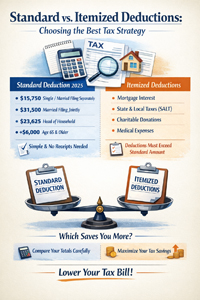
For 2025, the standard deduction amounts are:
- $15,750 for single filers or married filing separately
- $31,500 for married couples filing jointly
- $23,625 for head of household
- $31,500 for a qualifying surviving spouse
Additionally, taxpayers age 65 or older can claim an extra $6,000 for tax years 2025 through 2028 on top of their regular deduction.
There have also been changes to itemized limits. The SALT (state and local tax) deduction cap increases to $40,000 for married couples filing jointly in 2025.
Itemizing means listing eligible expenses individually—such as mortgage interest, qualifying state and local taxes, charitable contributions, and certain medical expenses above income thresholds. However, itemizing only makes sense if your total deductions exceed your standard deduction. For example, if you’re married filing jointly, your itemized expenses must exceed $31,500 to provide additional tax benefit. For many households, that threshold simply isn’t met.
The key is comparison. Tax planning should be guided by numbers—not assumptions. Run your totals both ways, especially if you purchased a home, made significant charitable donations, or had substantial medical expenses during the year.
Moral of the story:
At the end of the day, your goal is straightforward: legally reduce your taxable income and keep more of what you earn. A careful review now can translate into meaningful savings when you file.